TOP-RATED
Atlanta Criminal Defense
Law Firm
Atlanta Criminal Defense
Law Firm






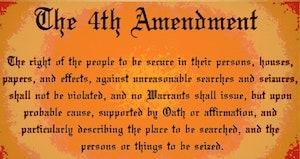
The Fourth Amendment bars unreasonable searches and seizures by government actors. It also requires that warrants rest on probable cause and describe exactly what police may search and seize. When officers ignore those limits, 4th amendment lawyers ask the court to exclude whatever the search produced.
Courts ask whether you had a reasonable expectation of privacy in the place searched. That means something you treat as private and society accepts as private: your home, the contents of your phone, your text messages, a locked trunk. Protection is weaker for what you expose to public view, such as the interior of a car visible through the window.
Georgia adds a second layer. Article I, Section I, Paragraph XIII of the Georgia Constitution contains a parallel search and seizure clause. Georgia courts have at times read it more broadly than the federal floor, so a search that survives federal analysis may still face a state challenge.
The remedy is the exclusionary rule. Mapp v. Ohio (1961) applied it to state prosecutions, so evidence taken in violation of the Fourth Amendment can be kept out of a Georgia trial. Whether a search crossed the line depends on the specific facts.
Most people arrive with the same question: was that legal? The answer usually turns on small details in the timeline. Common problems include pat-downs on the street, consent given after a long detention, searches called incident to arrest well after the arrest, and searches of phones taken at booking. Two scenarios drive most suppression litigation in Georgia.
An officer needs reasonable articulable suspicion of a violation to pull you over. The stop may last only as long as the original reason takes to address. In Rodriguez v. United States (2015), the Supreme Court held that police may not extend a completed stop to run a drug dog without independent suspicion. Body camera video often shows the citation finished minutes before a search began, and that gap supports a challenge to the extended detention.
Consent is a frequent flashpoint. Consent from a driver hemmed in by patrol cars and never told he may refuse may not be voluntary. Odor claims draw scrutiny too, because they rest on the officer's word alone.
Arizona v. Gant (2009) also limits vehicle searches after an arrest. Once the driver is handcuffed and secured, officers generally cannot search the passenger compartment unless evidence of the offense of arrest may be inside. In DUI cases, Georgia's implied consent framework does not erase Fourth Amendment analysis of a warrantless blood draw.
The home receives the strongest protection the Fourth Amendment offers. Warrantless entry into a residence is presumptively unreasonable, and the State carries the burden of justifying it.
A valid Georgia search warrant requires a neutral magistrate, a sworn affidavit establishing probable cause, and particularity about the place searched and the items sought. Georgia's search warrant statute sets out the grounds on which a magistrate may issue one.
Defects show up often: stale information, an unnamed informant with no corroboration, or an item list so broad it works like a general warrant. Officers may also exceed the warrant's scope once inside, opening rooms or containers the document never covered.
Third-party consent has limits. A roommate or partner may open the door, but that authority may not extend over a present, objecting occupant.
A warrantless search is not automatically illegal. Courts recognize several exceptions, and each carries a limit that often decides the motion.
Consent. A search is lawful if you voluntarily agree, but consent that follows an unlawful detention may not count.
Plain view. An officer in a lawful position may seize contraband that is immediately apparent, though not if he had to move or open something to see it.
Search incident to lawful arrest. Police may search the person and the area within reach, provided the arrest itself was lawful.
Exigent circumstances. Hot pursuit, imminent destruction of evidence, and emergency aid can excuse a warrant, but the emergency generally must be real.
The automobile exception. Probable cause to believe a vehicle holds evidence generally allows a search, and a hunch does not qualify.
Inventory searches. After a lawful impound, officers may catalog a vehicle's contents, but the search must follow standardized department policy rather than serve as a pretext.
Phones stand apart. Riley v. California (2014) held that police generally need a warrant to search a cell phone, even one seized during an arrest. Carpenter v. United States (2018) applied a warrant requirement to historical cell-site location records.
These rules bend with the facts. The same police conduct can be lawful on one set of facts and suppressible on another.
The exclusionary rule is the engine of a search and seizure defense. When a search violates the Constitution, the court can bar the State from using what it found.
Wong Sun v. United States (1963) extends that reach. Under the fruit of the poisonous tree doctrine, evidence derived from the original illegality may also be excluded. That can cover the physical evidence, the statements you gave afterward, and items police later located using information from the first search.
Suppression often ends a case. A State that loses the drugs, the gun, or the blood result may dismiss or reduce the charges.
The challenge is raised in a written motion to suppress. It must state the grounds with enough particularity to put the State on notice. Courts set pretrial filing deadlines, and missing one can waive the issue, which is why early representation matters.
Real work happens before anything is filed. We request body-worn and dash camera footage, the incident report, the warrant and its supporting affidavit, radio logs, and the officer's training records. The timeline then gets rebuilt minute by minute.
Once a warrantless search is established, the burden generally shifts to the State to justify it. The State must produce a specific lawful basis rather than a general one.
At the hearing, the officer testifies about why the stop, entry, or search happened. Defense counsel cross-examines on the timeline and on the stated justification. Video is the pressure point, because the recording either matches the officer's account or it does not.
Three outcomes are realistic. The court may suppress the evidence, which can lead to dismissal or reduction. It may suppress part of it and narrow the State's case. Or it may deny the motion, in which case the issue is preserved for appeal.
Even a denied motion can help, because the State has watched its officer face cross-examination and may reassess the case. Past results do not guarantee a similar outcome.
Search and seizure work is local. Your motion is decided by the judge assigned to your case, and suppression practice varies by courtroom.
People searching for "4th amendment lawyers near me" in metro Atlanta usually want that kind of familiarity. Counsel who regularly appears in the Fulton County Superior Court and in the Superior, State, and municipal courts of DeKalb, Cobb, and Gwinnett knows how those judges run evidentiary hearings. Local counsel also knows how fast video must be requested before retention schedules overwrite it.
Use a short checklist:
Then ask what Fourth Amendment issue the lawyer sees in your facts, and where it is weak. A lawyer who describes both sides is giving you a real assessment. Kohn & Yager LLC handles criminal defense matters across Georgia, and suppression litigation is a routine part of that practice.
If you believe police searched you, your car, or your home unlawfully, act quickly. The evidence that supports a suppression motion has a shelf life.
Write down what happened while it is fresh: where you were stopped, what the officer said, whether anyone said you could refuse, who was present, and how long the encounter took. Save any video you recorded.
Do not discuss the search with law enforcement without a lawyer. Roadside and interview-room explanations become the State's evidence.
Timing matters here. Body camera and surveillance footage is often overwritten on a fixed retention schedule, and motions to suppress face pretrial deadlines.
A first consultation with Kohn & Yager LLC covers the stop or entry, the warrant if one exists, and an honest assessment of whether a suppression issue is there. Call Kohn & Yager LLC or submit the contact form for a free, confidential consultation about your search and seizure case. Every case is different and results depend on the specific facts.

A warrantless car search is not automatically illegal. Police may rely on probable cause under the automobile exception, on your consent, or on a lawful inventory after impound. If none applies, a motion to suppress may keep the evidence out.
Yes. Under the exclusionary rule, a court can bar evidence obtained through an unconstitutional search. Wong Sun v. United States (1963) extends that to evidence derived from the first illegality, including statements you gave afterward.
No. You may decline a search request, and declining is not evidence of guilt. Officers may still search if they have an independent legal basis. Say clearly that you do not consent, and never physically interfere.
The court sets the deadline, usually in a pretrial scheduling order after arraignment. Deadlines vary by county and by court. Missing one can waive the issue, so speak with counsel well before your first court date.
Generally not without a warrant. Riley v. California (2014) held that a phone's contents stay protected even during an arrest. Police may seize and secure the device, but searching it usually requires a warrant or valid consent.