TOP-RATED
Atlanta Criminal Defense
Law Firm
Atlanta Criminal Defense
Law Firm




Getting pulled over for suspected drunk driving is stressful. Understanding what happens after a DUI pullover in Georgia matters greatly. This includes your rights and the consequences of refusing tests. This guide explains the legal process at DUI pullovers and drunk driving checkpoints, proper police procedures, and possible conviction penalties. Repeat offenders face much steeper penalties. A 3rd DUI in Georgia brings far harsher consequences.
Police in Georgia are trained to look for signs of impaired driving. They watch for these common triggers:
Once an officer stops your vehicle, the officer may question you. The officer will watch your speech and body language. Police may use body cameras and dash cameras to record your speech and actions. Everything you say and do will likely be used by the prosecutor to convict you of drunk driving.
Police may ask you to perform field sobriety tests. These include the horizontal gaze nystagmus test, the walk-and-turn, and the one-leg stand. These tests assess balance, coordination, and thinking as signs of drinking.
You are not legally required to take field sobriety tests in Georgia. Refusing these tests does not result in an automatic license suspension (unlike refusal of a chemical test). In Ammons v. State, 315 Ga. 149 (2022), the Georgia Supreme Court held that your refusal to perform field sobriety tests cannot be used against you at trial. Refusing may still raise suspicion with the officer.
Medical issues, bad weather, and roadside conditions can unfairly affect your performance. You have the legal right to politely decline the officer's request.
Georgia law prohibits driving with an alcohol concentration of 0.08 grams or more for most adult drivers. Commercial drivers face a 0.04 gram limit. Drivers under 21 face a 0.02 gram limit.
Police can determine your current blood alcohol level through breath tests or blood and urine tests. A breath test usually consists of a roadside portable breathalyzer. A separate official chemical test follows at the police station, jail, or hospital. Blood or urine tests may be used after arrest if alcohol or drugs are suspected.
The portable breathalyzer is carried by police to quickly record your blood alcohol level. If the device shows you have been drinking, the officer will continue the DUI investigation. The officer will gather more evidence for the prosecution.
For commercial drivers, an arrest raises a separate question about keeping a CDL license after a DUI.
The prosecutor may build a case using several types of evidence. The officer's observations of poor driving matter. The portable breath test result matters. Body camera video of slurred speech or stumbling matters. Field sobriety test results matter. The smell of alcohol or marijuana from your car matters.

If you are arrested for DUI and the officer asks you to take a chemical test, Georgia's implied consent notice must be read aloud to you by the arresting officer.
Implied consent means that by driving on Georgia roads, on any state's license, you have already agreed to submit to a post-arrest breath, blood, or urine test. This applies when police have probable cause to arrest you for DUI.
The officer must read you the implied consent notice. This notice explains that a DUI test refusal leads to a license suspension of at least one year, after the officer takes your license and issues a 45 day temporary permit.
By driving on Georgia roads, you have agreed to submit to chemical tests. These tests may involve your blood, breath, urine, or other bodily substances. These tests determine if you are under the influence of alcohol or drugs. If you refuse this testing, your Georgia driver's license or driving privilege will be suspended for a minimum of one year.
Once charges are filed, the case moves to an arraignment, where a plea is entered.
Refusing a field sobriety test carries no automatic penalty. Refusing a breath, blood, or urine test after a DUI arrest leads to a minimum one-year license suspension under Georgia's implied consent law.
Refusal of a breath test after being read the implied consent notice cannot be used as evidence against you at trial. The Georgia Supreme Court set that rule in Elliott v. State, 305 Ga. 179 (2019). The court held that Georgia's constitutional protection against compelled self-incrimination covers a breath test refusal. Refusal of a blood test is treated differently and may still be admitted at trial.
If you refuse, police might seek a warrant for a forced blood draw. Noncompliance with a court-ordered test risks additional criminal charges.
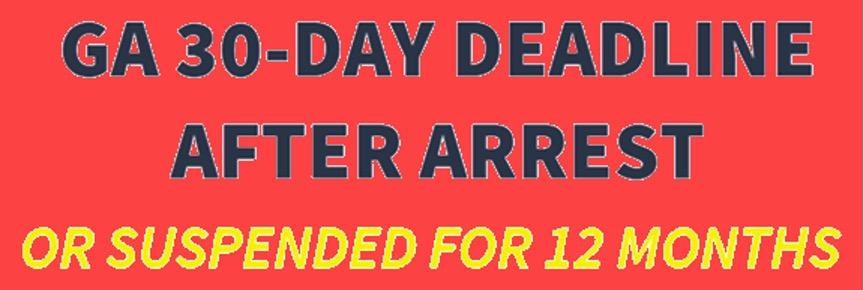
You can appeal a suspension by requesting an Administrative License Suspension hearing in writing, with a $150 filing fee, within 30 days of the date the officer serves your suspension notice. Do not wait too late. Call (404) 567-5515 and let our criminal attorneys fight to keep your license valid.
Modern law enforcement uses body cameras and police cruiser dash cameras to record traffic stops and DUI arrests. These recordings serve as critical evidence for both the prosecution and defense. They help clarify what happened during the DUI pullover.
An arrest video should prove whether field tests were properly given. It should show whether implied consent was read. It should demonstrate whether the stop was lawful.
A drunk driving checkpoint is a set location where law enforcement briefly stops vehicles to look for signs of impaired driving. It is also called a DWI checkpoint or sobriety checkpoint. Unlike a regular traffic stop, officers at a checkpoint do not need to observe a traffic violation before pulling you over. Instead, they follow a preset plan to screen drivers for possible intoxication.
Officers at these checkpoints do not pick and choose which vehicles to screen. Georgia's roadblock cases require that every vehicle reaching the checkpoint be stopped, not a selected few. Stopping all traffic prevents officers from singling out individual drivers based on appearance, vehicle type, or other subjective factors. The decision to run the checkpoint must come from supervisors before it begins, and the practice must hold throughout.
When your vehicle is stopped at a drunk driving checkpoint, the interaction is typically brief. An officer may ask for your license and registration. During this short conversation, the officer watches for common signs of impairment. These include the odor of alcohol, slurred speech, bloodshot eyes, or open containers in the vehicle. If nothing seems wrong, you are waved through in seconds. If the officer notices signs of impairment, you may be directed to a secondary screening area for further evaluation.
DWI checkpoints are constitutional under federal law. In Michigan Dept. of State Police v. Sitz, 496 U.S. 444 (1990), the U.S. Supreme Court held that sobriety checkpoints do not violate the Fourth Amendment. The Court balanced the minor intrusion on drivers against the government's strong interest in preventing drunk driving. The Court found the brief checkpoint stop reasonable.
Georgia courts apply their own requirements on top of that federal standard. In LaFontaine v. State, 269 Ga. 251 (1998), the Georgia Supreme Court set out a five-part test for checkpoint validity. A checkpoint must be ordered by supervisory personnel rather than by the officers working the road. Every vehicle must be stopped rather than a random few, and the delay to motorists must be minimal. The checkpoint must be clearly marked with signs, lights, or other warnings so approaching drivers know what they are encountering. The screening officer's training and experience must be enough to decide which drivers get field tests. On top of those five, federal law requires that the checkpoint's primary purpose be DUI enforcement – not a general search for unrelated criminal activity.
During major holiday enforcement periods, agencies across metro Atlanta often set up drunk driving checkpoints along busy corridors. Secondary screening areas are typically staged nearby. Officer to vehicle ratios are planned in advance to keep wait times short. If any of these legal requirements are missing or mishandled, a defense attorney may challenge the entire stop.
Stay calm: Provide your license, registration, and proof of insurance.
Know your rights: You do not have to answer potentially damaging questions about drinking or drug use. Politely decline.
Field tests: You may refuse field sobriety tests without automatic penalties, though refusal can raise suspicion.
Chemical tests: If arrested and read the implied consent notice, refusing the test can trigger administrative penalties.
Request an attorney: Ask for legal counsel as soon as you can. Contact Larry Kohn or Cory Yager.
Remember the body cam: Stay respectful and avoid saying something you will regret, as audio and video is being captured.
Listen carefully: Pay attention to whether the implied consent notice was read properly.
Observe results: Note the accuracy and admissibility of breath, blood, or urine test results.
Approaching a DWI checkpoint can feel intimidating. Knowing what to expect helps you stay calm and protect your rights. Here is what to keep in mind before, during, and after a checkpoint encounter.
You may legally turn around or take a side road before reaching a checkpoint. You must not commit a traffic violation in the process. Making a legal turn onto a side street is not, by itself, grounds for a stop.
But officers often station patrol units past the checkpoint. These units watch for drivers who make illegal U-turns, cross solid lines, or swerve erratically while trying to avoid the stop. If an officer observes a traffic violation during your maneuver, that violation gives the officer reasonable suspicion to pull you over.
Avoidance is legal. A traffic violation while avoiding it is not.
Keep your license, registration, and proof of insurance where you can reach them easily. When the officer approaches your window, hand over these documents promptly. The officer may ask where you are coming from or whether you have been drinking. You have the right to politely decline to answer questions that could be used against you. A simple "I prefer not to answer" is enough.
If the initial screening officer does not notice signs of impairment, you will be waved through quickly. If the officer detects the odor of alcohol, notices slurred speech, or observes other indicators, you may be directed to a secondary screening area. At that point, the encounter shifts from a checkpoint screening to a DUI investigation.
Officers may ask you to perform field sobriety tests. If they develop probable cause, they may arrest you and request a chemical test under Georgia's implied consent law.
The rules for field sobriety tests and chemical tests at a checkpoint are the same as at any other traffic stop. You may decline field sobriety tests without automatic penalties. If arrested and read the implied consent notice, refusing a breath, blood, or urine test triggers a minimum one-year license suspension under Georgia law.

An arrest at a drunk driving checkpoint does not mean the case is closed. A defense attorney can examine whether the checkpoint met Georgia's legal requirements. If it did not, any evidence gathered from the stop may be thrown out.
Several common challenges arise in checkpoint cases.
First, the checkpoint must have supervisory approval in advance. If a patrol officer set up the stop without authorization from a supervisor, the checkpoint may be unlawful.
Second, officers must stop every vehicle that reaches the checkpoint, for as long as it runs. If they waved some drivers through or targeted specific drivers, that requirement was broken.
Third, the checkpoint must be clearly visible to approaching motorists. Inadequate signage, poor lighting, or a hidden location can make the stop constitutionally deficient.
Fourth, the stop itself must be brief. If officers detained drivers for an unreasonable amount of time without developing individual suspicion, the intrusion may have exceeded what the law allows.
Finally, the checkpoint's stated purpose matters. Under City of Indianapolis v. Edmond, 531 U.S. 32 (2000), the U.S. Supreme Court held that checkpoints set up for general crime interdiction violate the Fourth Amendment. A Georgia checkpoint must have DUI enforcement as its primary purpose. If the real goal was to search for drugs or check for outstanding warrants, the stop may not survive a legal challenge.
When a court finds that a checkpoint was unconstitutional, evidence collected during the stop may be suppressed. This includes breath test results, field sobriety observations, and officer testimony. Without that evidence, the prosecution's case often falls apart. A defense attorney familiar with Georgia checkpoint law can review the specific facts and determine whether a challenge is worth pursuing.

A driver may lawfully avoid a checkpoint by making a legal turn or taking a different route. The key is that the maneuver itself must not break any traffic laws. An illegal U-turn, crossing a solid yellow line, or making a sudden unsafe lane change gives officers reasonable suspicion to pull you over. Law enforcement often positions patrol units beyond the checkpoint to watch for exactly this kind of evasive behavior. If you are stopped after trying to avoid a checkpoint, consult a defense attorney about the circumstances of your stop.
You should refuse field sobriety tests because there is no direct penalty for declining. Georgia's implied consent law reaches chemical tests of blood, breath, or urine, not field sobriety evaluations, so no license suspension follows a refusal, but an officer may still develop suspicion from other factors. Under Ammons v. State, 315 Ga. 149 (2022), your refusal to perform those tests cannot be used against you at trial.
If you refuse the breath test and police obtain a warrant, a forced blood draw may still happen. A warrant gives law enforcement the legal authority to take blood by force if necessary. Urine tests are typically requested by consent only.
A DUI checkpoint is a location where officers stop every passing vehicle to screen drivers for impairment. It is also called a drunk driving checkpoint or sobriety checkpoint. These checkpoints are legal in Georgia when they meet the requirements set out in LaFontaine v. State, 269 Ga. 251 (1998).
Those requirements are supervisory approval, stopping all vehicles rather than a selected few, minimal intrusion, adequate warning to drivers, and a trained screening officer. Federal law adds that DUI enforcement must be the checkpoint's primary purpose. If any of these factors were missing during your stop, a defense attorney may be able to challenge the checkpoint's legality. See the full checkpoint section above for more detail.
Likely yes. Body cameras and dash cameras capture most stops. This evidence is used in court. You should assume that audio and video are being recorded during any police encounter.
Georgia does not require law enforcement to publicly announce specific checkpoint locations in advance. But many agencies post general notices on social media or through local news outlets before holiday enforcement weekends. The lack of prior public notice does not make a checkpoint unconstitutional. What matters is whether the checkpoint met the LaFontaine criteria at the scene. Those criteria are supervisory approval, stopping all vehicles rather than a selected few, adequate warnings, minimal intrusion, and a trained screening officer, with federal law adding a legitimate DUI enforcement purpose.
If officers deviated from the required checkpoint procedures, a defense attorney can file a motion to suppress the evidence. Common procedural failures include waving some vehicles through instead of stopping all of them, lacking supervisory approval, or failing to post adequate signage. If a court agrees the checkpoint was unconstitutional, the prosecution may lose critical evidence. This includes breath or blood test results, officer observations, and any statements you made during the stop. This can lead to reduced charges or a full dismissal.
If you were arrested at a drunk driving checkpoint or during a DUI traffic stop in Georgia, the circumstances of your stop may provide grounds for a strong defense. Officers must follow strict legal requirements when conducting checkpoints. Any deviation from those rules could mean the evidence against you is subject to suppression.
Time is critical. Under Georgia law, you have only 30 days from the date the officer serves your suspension notice to request an administrative license suspension hearing, in writing and with a $150 filing fee. Missing that deadline waives the hearing and lets the suspension stand, which for a test refusal means a minimum of one year without your driving privileges.
Kohn & Yager LLC can review the details of your checkpoint stop. We can examine whether officers followed Georgia's legal requirements. We can help you understand your options. Call (404) 567-5515 to schedule a free consultation.
