TOP-RATED
Atlanta Criminal Defense
Law Firm
Atlanta Criminal Defense
Law Firm




During an Atlanta DUI stop, officers use three standardized field sobriety tests to assess impairment. These are the Horizontal Gaze Nystagmus (HGN) test, the Walk and Turn test, and the One-Leg Stand test. The National Highway Traffic Safety Administration developed these three exercises as a standardized battery. Georgia officers are trained to administer them in a specific sequence. But none of these roadside tests are scientific instruments. They are observational tools. They are designed to be difficult even for sober individuals.
You do not have to wait until morning. Our criminal defense law firm offers a FREE lawyer consultation with a co-author of Georgia’s leading DUI law book and can be reached 24 hours a day at (404) 567-5515.
If an officer deviates from the way they were trained, a DUI attorney near me can challenge the weight of the test results. Whether the NHTSA standardized field sobriety tests are voluntary in the first place is a separate question worth understanding before any roadside encounter. Politely decline if asked to perform field sobriety tests. These exercises can be used as evidence to support a DUI charge under Georgia law, even when your blood alcohol level is below 0.08 grams – if the officer believes you are less safe to drive.
The HGN or DUI eye test is different from other field sobriety tests in Atlanta DUI stops because its result is scientific evidence. Under Georgia's rule for expert and scientific evidence, the judge decides whether a jury may hear it. The prosecutor must show that the method itself is reliable. The prosecutor must also show that the officer applied that method reliably to the facts of your case.
Nystagmus is an involuntary jerking or bouncing of the eye. While nystagmus occurs naturally at extreme side gaze in all people, alcohol and certain central nervous system depressants cause this jerking to become more pronounced. It appears at lesser angles as well. That is what makes the HGN useful to officers during a DUI stop.
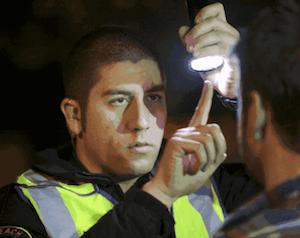
The HGN is often the first field sobriety test an officer administers. The officer holds a stimulus – usually a pen or small flashlight – approximately 12 to 15 inches from the driver's nose, slightly above eye level. Before scoring begins, the officer should check for equal pupil size and resting nystagmus. The officer should verify that both eyes track the stimulus together (equal tracking).
The officer looks for three specific clues in each eye. That gives a total of six possible clues:
According to the NHTSA manual, four or more clues out of six indicates a likelihood of impairment. The test should involve two passes for each clue and two passes for equal tracking. That is a total of approximately 14 passes. When performed correctly, the entire HGN test takes roughly 82 seconds.
The DUI nystagmus test is the common name for the HGN evaluation when it is administered during a suspected drunk driving stop. Officers use it because alcohol predictably affects the smooth-pursuit mechanism of the eyes. When a person's blood alcohol level rises, the central nervous system becomes less able to control eye movement. Nystagmus appears at angles where it would not otherwise occur.
But alcohol is not the only cause of nystagmus. Many conditions can produce the same involuntary eye jerking that officers score as clues during a DUI nystagmus test:
Defense attorneys often examine common administration errors. These include moving the stimulus too quickly or too slowly. They include holding it too close or too far from the driver's face. They include failing to check for equal pupil size and resting nystagmus before beginning. Roadside conditions also matter. If flashing patrol lights are positioned behind the officer during the test, the strobing can affect the driver's eye movement and produce unreliable results.
Under Georgia's rule for expert and scientific evidence, improper administration of the HGN may affect whether the results come into evidence at trial. Georgia courts once judged this evidence by the older Harper test, but that test does not apply to cases tried after July 1, 2022. If the prosecution cannot show that the officer applied the method reliably, the defense may challenge the admissibility of the HGN findings. The defense may challenge not just their weight.
The walk and turn is a divided attention test. It requires a driver to listen to instructions and remember them. It requires the driver to perform physical movements at the same time. This mirrors the divided attention that driving demands.
During the instruction phase, the officer directs the driver to stand heel-to-toe on a real or imaginary line. The right foot should be in front of the left foot. Arms should be at the sides. The driver must remain in that position while listening. The driver must not begin walking until told to do so.
Once the officer gives the signal, the driver takes nine heel-to-toe steps down the line. The driver makes a specific turn by taking small steps around the planted front foot. Then the driver takes nine heel-to-toe steps back. The driver should count each step aloud. The driver should watch their feet. The driver should keep their arms at their sides throughout.
How many clues for walk and turn does the officer score? The NHTSA manual identifies eight standardized walk and turn clues:
According to the NHTSA manual, two or more clues indicates a likelihood of impairment. But many sober people miss clues on this test. Age, weight, footwear, medical conditions affecting balance or mobility, and the surface where the test is conducted all play a role. Gravel shoulders, sloped pavement, and high-heeled shoes make it substantially harder to walk a straight line. This is true regardless of sobriety.
All good DUI defense lawyers will review your arrest video to see if the officer made any mistakes while conducting this test.
The one-leg stand is a divided attention test. The officer asks the driver to stand with one foot approximately six inches off the ground, toe pointed. Both arms should be at the sides. The driver must look down at the raised foot and count aloud – "one thousand one, one thousand two" – until the officer says to stop. The counting continues for approximately 30 seconds.
The NHTSA manual identifies four standardized clues for the one-leg stand:
Two or more clues indicates a likelihood of impairment according to the NHTSA manual. Even so, the one-leg stand's accuracy rate in NHTSA validation studies falls well below perfect. Physical factors that have nothing to do with alcohol can legitimately affect performance. People over age 65 may struggle with this exercise. Individuals with back, leg, or inner ear conditions may struggle with it. Anyone wearing shoes with heels over two inches may struggle with it. All of these people can be completely sober.
A more detailed breakdown of each roadside exercise appears in part two of our field sobriety tests explained series.
Some juries treat field sobriety test results as near-definitive proof of impairment. Others recognize how difficult these exercises are even for sober people and place less weight on them. The outcome often depends on how well the jury understands the tests and their limitations.
Law enforcement officers in Atlanta follow the same national NHTSA training as officers throughout Georgia. They use a standardized administration protocol. But whether SFST evidence carries weight at trial often depends on whether the officer administered the tests exactly as trained. If the defense can show administration errors, the clue counts may lose their persuasive value.
An HGN stimulus moved too fast is an administration error. Walk and turn instructions given on a sloped surface is an administration error. A one-leg stand timed incorrectly is an administration error.
Field sobriety tests are completely voluntary in Georgia. A person does not have to perform them. You have the right to politely decline.

If you were asked to perform field sobriety tests during an Atlanta DUI stop, the details of how the officer administered each test matter. A careful review of dashcam or body camera footage can reveal whether the HGN was administered the way the officer's training requires. The review can show whether the walk and turn instructions were given properly. It can show whether the one-leg stand was timed and scored correctly.
Clue-scoring errors and administration problems may affect both the admissibility and the weight of SFST evidence in your case. Call one of our DUI defense attorneys in Atlanta for a free consultation. Tell us which sobriety tests you took or declined, and we can help you understand how to move forward.

The NHTSA manual identifies eight standardized clues on the walk and turn test. These are: cannot keep balance during instructions, starts too soon, stops while walking, does not touch heel-to-toe, steps off the line, uses arms for balance, improper turn, and incorrect number of steps. Two or more clues may indicate impairment. But many sober people exhibit clues due to age, footwear, or roadside conditions.
The officer instructs the driver to stand heel-to-toe on a line with arms at sides and to listen without starting to walk. Once told to begin, the driver takes nine heel-to-toe steps, makes a turn using small steps, and takes nine steps back. The driver should count each step aloud and watch their feet. Any deviation from these instructions may be scored as a clue.
The DUI nystagmus test is the Horizontal Gaze Nystagmus (HGN) evaluation. An officer moves a stimulus in front of the driver's eyes and looks for involuntary jerking. While it may indicate impairment, nystagmus can also be caused by medications, neurological conditions, fatigue, or flashing lights. In Georgia, HGN results must satisfy the state's rule for expert and scientific evidence before a jury hears them. Administration errors may affect whether the evidence is admitted at trial.
No. Field sobriety tests are voluntary in Georgia. You may politely decline to perform the HGN, walk and turn, and one-leg stand without facing an automatic license suspension. You will not face other direct penalty for the refusal itself. But the officer may still decide to arrest you based on other observations. Consult a Georgia DUI attorney about your specific situation.