- Free Consultation, Call 24/7: (404) 567-5515 Tap Here To Call Us




If You Are Convicted of DUI in Georgia, Your Fine and Jail Time Will Be Increased If These Facts Apply



The Baseline: What Georgia Requires Before Any Aggravation

Drivers arrested in Atlanta, Marietta, Decatur, Alpharetta, Lawrenceville, or Jonesboro ask our DUI attorneys the same first question. How much will this cost me, and am I going to jail? If you are convicted of DUI, your fine and jail time will be increased if certain facts are in your case. Some of those facts are written into the statute. Others are left to the judge.
Georgia sets the floor in its DUI statute. A first or second conviction is a misdemeanor. A third conviction is a high and aggravated misdemeanor. A fourth or later conviction is a felony. Georgia law counts prior offenses inside a ten-year window, measured from arrest date to arrest date. Every tier carries a fine range, a jail range, community service, DUI school, and a clinical evaluation. These numbers are minimums, not ceilings.
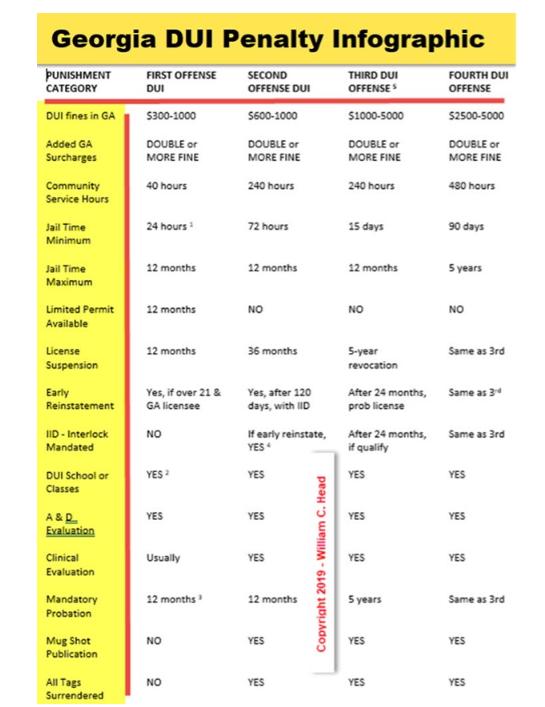
| Conviction (ten-year window) | Fine | Jail range | Jail that must be served | Community service |
|---|---|---|---|---|
| First DUI | $300 to $1,000 | 10 days to 12 months | 24 hours when the alcohol level was 0.08 or more | 40 hours |
| Second DUI | $600 to $1,000 | 90 days to 12 months | 72 hours | 30 days |
| Third DUI (high and aggravated) | $1,000 to $5,000 | 120 days to 12 months | 15 days | 30 days |
| Fourth or later DUI (felony) | $1,000 to $5,000 | 1 to 5 years | 90 days | 60 days |
Every conviction also requires a DUI Alcohol or Drug Use Risk Reduction Program within 120 days, a clinical evaluation, and any treatment that evaluation recommends. Probation runs 12 months for a misdemeanor, less any days already served, and five years for a felony DUI. The fine cannot be suspended, stayed, or probated. A judge may allow installment payments in a hardship case, or suspend up to half the fine if the driver completes a treatment program. A judge cannot simply waive it.
In our experience, especially on a first offense DUI, a careful review of the stop, the field tests, and the breath or blood test often turns up a flaw in the State's case. That is why the facts below matter most before a plea, not after it.
Prior DUI Convictions Within Ten Years: The Only Automatic Increase
This is the one increase the legislature took out of the judge's hands. The higher fines and mandatory jail days in the table above apply automatically once a prior conviction falls inside the ten-year window. The window runs from the date of the earlier arrest to the date of the current arrest. Conviction dates do not matter.
Metro Atlanta drivers often underestimate five consequences of a prior:
- A nolo plea still counts. For sentencing, a plea of nolo contendere to a DUI charge is treated as a conviction. Read more about the nolo plea in a Georgia DUI case.
- Out-of-state and city cases count. A conviction under federal law, a local ordinance that adopts the state statute, or another state's substantially similar law counts as a Georgia prior. An old South Carolina, Alabama, Tennessee, or Florida case can turn a metro Atlanta "first offense" into a second DUI offense with 72 hours of mandatory jail.
- Your name and photo go in the newspaper. After a second or later conviction within five years, the clerk must publish a notice of conviction, with the arrest photo, in the county's legal organ. The driver pays a $25 assessment for it.
- Your license plates are surrendered in court. After a second or later conviction within five years, the plate surrender law requires the court to order the plates on every vehicle registered in your name turned in and revoked. A special hardship plate is possible for a family member who depends on the car.
- A third conviction cuts your jail credit. A third DUI is a high and aggravated misdemeanor. Under the earned time limit for that class of offense, a jail can award no more than four days of earned time per month. A 12-month sentence therefore means well over ten months actually served.
Three DUI convictions within five years also make the driver a habitual violator, which revokes the license for five years. A habitual violator who is arrested for another DUI faces vehicle forfeiture on top of the criminal case. Our habitual violator guide explains how that status works.
A Breath or Blood Alcohol Level Above 0.15
Georgia has no separate crime called "aggravated DUI" or "high BAC DUI." On paper, a first offense with a 0.16 reading carries the same minimums as a 0.09 reading. In the courtroom, the sentence is usually not the same at all. Two things change when an Intoxilyzer 9000 or a GBI blood test comes back above 0.15.

First, the statute closes the nolo door. The nolo plea rules bar a judge from accepting a nolo contendere plea when the alcohol concentration was more than 0.15. For a first offender in a municipal court in Sandy Springs, Roswell, Decatur, Smyrna, Johns Creek, or Duluth, that removes one of the few tools that can soften the license outcome.
Second, judges and solicitors treat the number as an aggravator. Within the range the statute already allows, a 0.19 result routinely produces more actual jail, a longer probation tail, weekend confinement or an inpatient alternative, an ignition interlock condition, and less willingness to reduce the charge to reckless driving. It also shapes the mandatory clinical evaluation, which sets the length and cost of the treatment the court orders.
So if you are convicted of DUI, your fine and jail time will be increased if the State's test result sits well above the legal limit. Not because a different code section applies, but because every discretionary decision tilts against you. This is exactly where challenging the breath machine's operation, the blood draw chain of custody, and the implied consent advisement matters most.
Physical Resistance to the Arresting Officer
Nothing raises a DUI sentence in a metro Atlanta courtroom faster than a struggle with the officer. The exposure comes from a separate criminal code section, not the DUI statute.
Knowingly obstructing or hindering an officer in the lawful discharge of official duties is a misdemeanor under Georgia's obstruction statute. That is a second 12-month sentence a judge can stack on top of the DUI sentence. Police add the charge for pulling away, refusing to be handcuffed, or going limp so that officers have to carry the driver to the patrol car.
Obstruction becomes a felony when the resistance involves "offering or doing violence" to the officer. The penalty is one to five years for a first conviction, two to ten years for a second, and three to 15 years for a third. Throwing or spitting blood, urine, vomit, or other bodily fluids at an officer is its own felony carrying one to five years. It surfaces more often than people expect in DUI arrests involving vomiting in a patrol car or at jail intake. Every obstruction conviction also carries a $300 minimum fine.
When an officer is treated at Grady Memorial, Wellstar Kennestone, Piedmont Atlanta, or Northside Hospital, and body camera footage shows the injury, expect the case to move from a misdemeanor DUI court to a Superior Court felony indictment. The DUI becomes an accompanying count. Medical treatment of an officer also nearly guarantees the State will oppose any lenient plea. Do not resist or fight with a police officer. It turns a bad traffic case into a serious felony charge.
A Child Under 14 in the Vehicle
Georgia does not merely enhance a DUI when children are on board. It creates a second crime for each child passenger.
A driver who violates the DUI statute while transporting a child under the age of 14 is guilty of the separate offense of endangering a child by driving under the influence. The statute states that this offense "shall not be merged" with the DUI for prosecution and sentencing. The Court of Appeals enforced that command in Slayton v. State, rejecting a defendant's request to merge the two convictions.
The child endangerment penalties break down as follows:
| Endangering a child by DUI | Grade | Penalty |
|---|---|---|
| First or second offense | Misdemeanor | Up to $1,000, up to 12 months, or both |
| Third or later offense | Felony | $1,000 to $5,000, one to three years, or both |
Because each qualifying child supports a separate count, one traffic stop on I-285 with two children in car seats can produce a DUI plus two child endangerment counts. Those counts also accumulate as priors. A driver with two earlier child endangerment convictions reaches the felony tier on the third, even on a first DUI.
The collateral consequences compound the sentence. A child endangerment allegation frequently triggers a report to the Division of Family and Children Services. It can also surface in a Fulton, DeKalb, Cobb, Clayton, or Gwinnett County custody or visitation case, entirely apart from what the criminal judge orders.
Causing a Collision Through Your Own Driving
A DUI arrest that follows a wreck is a different case from a DUI arrest that follows a lane-position stop on Peachtree Street, even when the citation reads the same. Four levels of exposure apply.

Property damage and minor injury. Within the misdemeanor range, a crash you caused is the classic reason a metro Atlanta judge orders actual jail instead of probated time, adds restitution as a probation condition, and imposes the full 12-month probation term.
Serious injury by vehicle. Under Georgia's serious injury by vehicle statute, causing an accident that results in bodily harm while driving under the influence is a felony punishable by one to 15 years. "Bodily harm" means losing a body member, losing the use of one, serious disfigurement, or organic brain damage. There is no misdemeanor version. A first-offense DUI driver can become a convicted felon on this count alone. Read our page on DUI with serious injury in Georgia.
Leaving the scene. Causing an accident the driver knew resulted in bodily harm, then leaving without exchanging insurance information, is a separate felony carrying one to ten years.
A fatality. Where a DUI crash kills someone, the homicide by vehicle statute governs. First-degree homicide by vehicle carries three to 15 years. A habitual violator driving on a revoked license who causes a death faces five to 20 years. At least one year must be served before any part of the sentence can be probated.
A conviction for serious injury by vehicle or first-degree homicide by vehicle also suspends the driver's license for three years, with no early reinstatement and no limited permit.
Same Statute, Very Different Metro Atlanta Courtrooms
The DUI statute applies identically in every county. Where your case is docketed still shapes how the aggravating facts get handled.

- State Courts in Fulton, DeKalb, Gwinnett, Cobb, Clayton, Henry, Cherokee, Douglas, Rockdale, and Forsyth counties handle most misdemeanor DUI prosecutions. Each solicitor-general's office has its own policy on reductions and on stacked obstruction or child endangerment counts.
- Municipal Courts in Atlanta, Marietta, Sandy Springs, Alpharetta, Roswell, Johns Creek, Decatur, Duluth, and dozens of smaller cities can impose the full misdemeanor and high and aggravated misdemeanor punishments, regardless of any limit in the city charter. A city court is not a lesser court on sentencing power.
- Superior Courts are the only courts that can take felony DUI, serious injury by vehicle, vehicular homicide, and felony obstruction cases by indictment. In smaller counties with no State Court, the Superior Court is also the only court that can offer a jury trial.
- Accountability courts are the counterweight. Programs such as Cobb State Court's DUI Court, Fulton County's Recovery Treatment Court, and the Clayton County DUI Court offer intensive supervision and treatment tracks for repeat drunk driving offenders.
Our Fulton County, DeKalb County, Cobb County, Gwinnett County, and Clayton County pages explain how each court system handles a DUI case.
Your License Runs on a Separate Five-Year Clock
For repeat offenders, the criminal sentence is only half the punishment. The license suspension periods run on a five-year look-back, not the ten-year criminal window:

- First conviction in five years: a 12-month suspension, with early reinstatement possible after 120 days once DUI school is complete and a $210 restoration fee is paid ($200 by mail).
- Second conviction in five years: a three-year suspension. No reinstatement application until 18 months have passed, plus one year with an ignition interlock device tied to an interlock limited permit, unless the interlock is waived for financial hardship.
- Third conviction in five years: habitual violator status and a five-year revocation.
The administrative suspension is a separate, faster clock. After a refusal or a test over the limit, the officer serves a notice that starts a 30-day deadline to request an ALS hearing or elect an interlock permit. Miss it, and the license is suspended long before the first court date. Our license penalties page covers every suspension scenario.
Talk to an Atlanta DUI Lawyer Before Sentencing, Not at It
Most of the increases on this page are fought before sentencing. Excluding a prior from the ten-year count, suppressing a breath test above 0.15, challenging whether a child was actually "transported," disputing causation in a collision case, and dismantling a felony obstruction allegation on the video are all pretrial battles. Once a plea is entered, the mandatory minimums leave a judge very little room.
No lawyer can guarantee a result. Every case turns on its own facts, its own video, and its own evidence. If your DUI case involves any of the aggravating facts above, anywhere in the greater metro Atlanta area, have it reviewed while the license and criminal deadlines are still open. Call (404) 567-5515 or use our contact form for a free consultation. We answer 24 hours a day.

Frequently Asked Questions
When Is a Georgia DUI Fine and Jail Sentence Increased Automatically?
Only a prior DUI conviction inside the ten-year window forces an automatic increase. A second conviction raises the minimum fine to $600 and requires at least 72 hours in jail. A third raises the fine range to $1,000 to $5,000 with 15 days served. A fourth is a felony carrying one to five years with 90 days served.
Does a BAC Over 0.15 Carry a Longer Mandatory Jail Sentence in Georgia?
No separate mandatory minimum applies. A reading over 0.15 does bar a nolo contendere plea. Judges and solicitors in metro Atlanta also treat a high reading as grounds for more actual jail, longer probation, interlock conditions, and more intensive treatment.
Is a DUI With a Child in the Car a Separate Charge in Georgia?
Yes. Driving under the influence with a child under 14 in the vehicle is the separate offense of endangering a child by DUI. Each child is a separate count, and the count cannot be merged with the DUI. A first or second offense is a misdemeanor. A third is a felony.
What Happens If I Resisted the Officer During a DUI Arrest in Atlanta?
Obstruction is a separate misdemeanor charge with its own 12-month sentence. If the resistance involved offering or doing violence to the officer, it is a felony carrying one to five years for a first conviction, two to ten years for a second, and three to 15 years for a third, plus a minimum $300 fine.
Can a First-Offense DUI in Georgia Be a Felony If I Caused a Wreck?
Yes. Causing an accident that results in bodily harm while driving under the influence is serious injury by vehicle, a felony punishable by one to 15 years, with no misdemeanor version. A fatality is prosecuted as homicide by vehicle in the first degree, which carries three to 15 years. See our page on whether a DUI is a felony in Georgia.
Do Out-of-State DUI Convictions Count Against Me in Georgia?
Yes. A conviction under federal law, a local ordinance that adopts the state statute, or another state's substantially similar DUI law counts as a prior when Georgia computes your offense number.