TOP-RATED
Atlanta Criminal Defense
Law Firm
Atlanta Criminal Defense
Law Firm





By: Atlanta DUI and Criminal Defense Attorney William C. Head, Georgia Law Book Author or Co-author since 1995
Georgia DUI laws live in Title 40 of the Official Code of Georgia Annotated. That is the state's book of motor vehicle and traffic laws. A handful of its sections control every drunk driving case in the state. They set out what a DUI is, what a conviction costs, and what happens to your license.
This page walks through those GA DUI laws one section at a time. You will find the elements of the offense, a penalty chart by number of prior convictions, and the license rules that follow an arrest. Every section links to the current text of the statute.
Our three DUI lawyers have written or co-written Georgia's leading DUI legal treatise since 1995. We explain Georgia DUI law here the way we explain it to clients. Call 404-567-5515 any time, day or night, for a free consultation.

Above, a Tennessee radio host praises William Head's first DUI book. That book grew into the Georgia DUI Trial Practice Manual, updated every year.
Georgia's driving under the influence statute is the heart of the state's DUI laws. It lists six separate ways a driver can commit the offense. A person may not drive or be in actual physical control of a moving vehicle in any of these six conditions.
The first four are the less safe DUI provisions. The State does not need a number. It needs proof that alcohol or drugs made you a less safe driver. The fifth is the per se alcohol offense. A test at 0.08 or above is a violation on its own. The sixth is the per se drug offense. It is subject to one limit. A driver who is legally entitled to use a drug violates the section only if the drug left him or her incapable of driving safely.
Three special rules sit inside the same statute. A driver under 21 violates it at 0.02 grams or more. A driver of a commercial vehicle violates it at 0.04. And a driver who commits DUI with a child under 14 in the vehicle commits a second, separate offense of DUI child endangerment. That charge does not merge with the DUI count.
Prosecutors often file two counts from one arrest, a less safe count and a per se count. Our guide to a DUI combination of A1 and A5 explains what each count requires and how the pair is defended. Even without a test result, a driver can be convicted of DUI less safe on admissions, officer observations, field sobriety tests, and video.
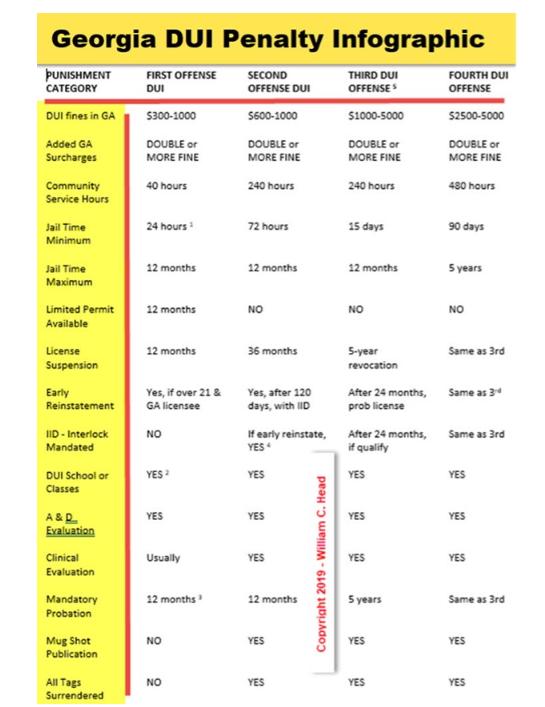
Georgia DUI law grades DUI offenses by prior convictions within ten years. The ten years run from the date of the earlier arrest to the date of the new arrest. A first or second conviction is a misdemeanor. A third is a high and aggravated misdemeanor. A fourth or later conviction is a felony. The chart below gives the sentencing terms the statute requires.
| Conviction within ten years | Fine | Jail range | Jail that must be served | Community service |
|---|---|---|---|---|
| First DUI | $300 to $1,000 | 10 days to 12 months | 24 hours when the alcohol level was 0.08 or more | 40 hours |
| Second DUI | $600 to $1,000 | 90 days to 12 months | 72 hours | 30 days |
| Third DUI (high and aggravated) | $1,000 to $5,000 | 120 days to 12 months | 15 days | 30 days |
| Fourth or later DUI (felony) | $1,000 to $5,000 | 1 to 5 years | 90 days | 60 days |
Every tier adds the same conditions. The driver must finish a DUI Alcohol or Drug Use Risk Reduction Program within 120 days of conviction. That is the course most people call DUI school. The driver must also complete a clinical evaluation, which a judge may waive on a first offense, and any treatment it recommends. Probation runs 12 months for a misdemeanor, less any days served in jail. Felony probation runs five years.
The fine cannot be suspended, stayed, or probated. A judge may allow payments in a hardship case. A judge may also cut up to half of the fine if the driver completes a substance abuse treatment program. The First Offender Act does not apply to a DUI conviction. Georgia's DUI laws say so directly.
On a first offense DUI, the 24 hours in custody is the number most drivers ask about. Our blog post on first offense DUI laws and penalties covers the full sentence in detail. The judge may probate the rest of the ten-day minimum when the alcohol level was 0.08 or more. For a second DUI in GA within ten years, the jail floor jumps to 72 hours of actual custody. A second conviction within five years also brings a published notice of conviction, with the driver's photo, in the county legal newspaper. The driver pays $25 for it.
Georgia counts by the ten-year window, not by lifetime. A driver with a DUI conviction from 12 years ago faces the first offense terms again. Our page on DUI penalties in Georgia covers the collateral costs that the chart leaves out. For the changes made this year and the BAC limits by driver type, see our guide to new Georgia DUI laws in 2026.
A DUI conviction suspends your license by operation of law. The license suspension statute uses a five-year window here, not the ten-year window used for sentencing. The DUI laws in Georgia measure both windows from arrest date to arrest date.

On a first conviction in five years, the suspension is 12 months. After 120 days, the driver may apply for early reinstatement. That requires proof of the risk reduction course and a $210 restoration fee, or $200 by mail. During those months, a driver with no DUI in the past five years may ask for a limited driving permit. The permit costs $32 and lasts one year. It allows driving to work, school, medical care, court, and treatment.
A second conviction within five years suspends the license for three years. Full reinstatement is not available until 18 months have passed. A driver may apply for an ignition interlock device limited driving permit after serving 120 days of that suspension. Reinstatement then requires a year of interlock on the vehicle. The court also orders the driver to surrender the license plates of every vehicle registered in his or her name.
A third DUI conviction within five years makes the driver a habitual violator. The Department of Driver Services revokes the license for five years. Driving during that revocation is a felony. The habitual violator statute is also what triggers vehicle forfeiture, covered below.
Drug DUI convictions follow a separate drug suspension rule. A first conviction suspends the license for at least 180 days. Reinstatement requires the risk reduction course and the same restoration fee.
The license fight starts long before a conviction. Under Georgia's implied consent law, every driver has agreed to state chemical testing after a lawful DUI arrest. The law enforcement officer reads a notice and asks for breath, blood, or urine. A refusal brings a one-year administrative suspension. A test result of 0.08 or more, or 0.02 for a driver under 21, brings a suspension too.
The officer takes the plastic license and issues a 45-day temporary permit. The driver then has 30 days to act. The two choices are a written hearing request with a $150 filing fee, or, for an eligible driver, an ignition interlock permit application. Taking the interlock permit waives the hearing. Missing the 30-day window waives the hearing too, and the suspension takes effect. Our article on what GA implied consent law means walks through that decision.
A refusal of a blood or urine test may be used against the driver at trial. A refused breath test is treated differently under Georgia case law, and our lawyers raise that issue in nearly every refusal case.

The sections below round out Georgia DUI law. Each one changes the outcome of some cases.
Nolo contendere pleas. Under the nolo contendere rule for DUI, the judge alone decides whether to accept a no contest plea. No nolo plea is allowed when the alcohol concentration was above 0.15, or for any driver under 21. A nolo plea still carries the full DUI sentence. It does not avoid the license suspension, because the suspension statute counts an accepted nolo plea as a conviction.
Vehicle forfeiture. The vehicle forfeiture statute declares the car contraband when a habitual violator with three DUI convictions is arrested for DUI again on a revoked license. The State may seize it. A court may transfer the only family car to another licensed family member when the hardship outweighs the benefit to the State.
School bus drivers. A licensed school bus driver convicted of DUI while driving a school bus faces one to five years in prison, a fine of $1,000 to $5,000, or both.
Chemical test rules. The chemical test admissibility statute sets the rules for the State's breath, blood, and urine evidence. For a breath test, the State must request two sequential samples. The two readings must be within 0.020 of each other. The lower result controls the charge and the license suspension. Only a physician, nurse, lab technician, EMT, or other qualified person may draw blood. And every driver may obtain an independent test of his or her own choosing. Our page on how to challenge your breathalyzer results covers what happens when the State misses one of those steps.
Young drivers. A driver under 21 faces DUI at 0.02, has no nolo option, and on a 0.02 conviction must finish community service within 60 days of sentencing. See our page on underage DUI charges in Georgia.
A fourth or later DUI conviction within ten years is a felony under Georgia DUI law. It carries one to five years, with 90 days that must be served. A first, second, or third conviction is a misdemeanor or a high and aggravated misdemeanor. A DUI crash that causes serious injury or death is charged under separate felony statutes. Our page on whether a DUI is a felony in GA covers those charges.
Yes, for most drivers convicted of a first offense DUI in Georgia. A driver with no DUI conviction in the past five years may apply for a limited driving permit after the conviction. The permit lasts one year and covers work, school, medical care, court, and treatment. Full reinstatement is available after 120 days once DUI school is complete and the restoration fee is paid.
No. The DUI statute states that first offender probation does not apply to a DUI conviction. A reduced charge, such as reckless driving, is the usual path to keeping a DUI off the record.
Refusing to submit to the test triggers a one-year administrative license suspension. The driver has 30 days to request a hearing or, if eligible, apply for an ignition interlock permit. The refusal of a blood or urine test may also be offered as evidence at trial.
Call today for your free consultation with one of our three Atlanta DUI defense attorneys near me. Our goal will be to protect your ability to drive, avoid jail time, and find a non-DUI disposition for your case. 404-567-5515.

The information you receive at no cost from our lawyers near me free consultation may show you how your pending DUI case can be resolved in a favorable way. We answer the phone 24 hours a day.