TOP-RATED
Atlanta Criminal Defense
Law Firm
Atlanta Criminal Defense
Law Firm





If you were just pulled over for speeding in Georgia, you are facing more than a fine. Georgia treats every speeding citation as a criminal misdemeanor – not the civil infraction most drivers expect. That single difference changes how the case is heard, what it costs, and what it means for your record. This page covers how police prove speed in Georgia, what stop sign citations cost, work zone penalties, jail exposure at high speeds, the real total cost of a speeding ticket, and when it makes sense to call a lawyer. See our related guide: Classes of Misdemeanor: Understanding Misdemeanor Categories and Penalties.
Larry Kohn and Cory Yager are traffic ticket attorneys who focus on Georgia traffic and DUI defense. Cory Yager worked as a police officer before he practiced law, so he understands the speed detection side of a traffic stop first-hand. Kohn & Yager LLC offers a free consultation on any Georgia citation.
Yes. A misdemeanor speeding ticket in Georgia is a criminal charge rather than a civil infraction. Under Georgia law, a violation of the traffic code is a misdemeanor unless the statute declares otherwise. Speeding has no separate civil-offense designation, so the default misdemeanor rule applies. Receiving a misdemeanor for speeding in Georgia means the case is handled just like any other criminal matter.
Under Georgia law, a misdemeanor carries a maximum penalty of a fine up to $1,000 or confinement for up to 12 months, or both. However, speeding-specific fine caps under Georgia law are lower than the general misdemeanor maximum. For a first offense the cap runs from zero dollars for five mph or less over the limit up to $500 for speeds 24 to 33 mph over the limit.
The misdemeanor classification changes three practical things for the driver.
The case goes to a criminal court. Depending on the citing agency, the citation lands in a municipal court, a county recorder's court, a probate court, or a state court. A judge decides it – not a clerk or an administrative traffic bureau.
A conviction is a criminal conviction. It may appear on employment background checks, security clearance investigations, and immigration screenings. CDL holders face especially serious consequences because a misdemeanor traffic conviction can trigger federal disqualification rules. Many drivers learn this only after they mail in payment, which counts as a guilty plea.
Jail is legally on the table. The general misdemeanor statute allows confinement for up to 12 months. For a speeding-only charge at moderate speeds, courts rarely impose custody. But the exposure exists, and it increases sharply at extreme speeds or with prior convictions.
Drivers from other states are often surprised by this. Where they live, routine speeding may be a civil infraction that carries a fine but no criminal record. Georgia does not draw that line. A conviction here follows the driver in ways a civil infraction would not. A driver cited out of state should check whether that state treats the citation as a civil infraction or as criminal speeding.
Nolo contendere pleas. A nolo plea – no contest – results in a conviction for sentencing purposes. The court still imposes a fine, and a nolo plea keeps points off the record only once in any five-year period. The main advantage is that the plea cannot be used as an admission of liability in a later civil lawsuit. It does not erase the misdemeanor character of the offense.
Running a stop sign, failure to yield, improper lane change, and every other moving violation carry the same misdemeanor classification. That is why the stop sign section below matters as much as the speeding sections.
Georgia also tracks convictions through demerit points. The Department of Driver Services adds points for most moving violations and flags a license for suspension once the total crosses the threshold. Speeding adds no points below 15 mph over the limit, then 2 to 6 points as the clocked speed climbs. For many drivers, the points – not the fine – are what make a citation worth contesting.

A speeding charge is only as strong as the evidence behind it. Georgia does not let an officer simply state a number and call it proof. The Georgia traffic code sets unusually specific conditions on speed detection, and each condition creates a fact a defense lawyer can check.
The citing agency must hold a valid speed detection device permit from the Georgia Department of Public Safety. A lapsed or missing permit undercuts every radar and laser reading that agency writes.
Georgia requires signs warning motorists that speed detection devices are employed at the approaches to the jurisdiction, where a state highway crosses the boundary. Drivers are entitled to notice that speed detection is in use.
Devices must be tested and certified for accuracy, and the officer must be trained and certified to run them. Certification gaps happen more often than drivers assume.
The ten-miles-per-hour margin for local speed detection cases also sets a floor. A county, city, or campus officer cannot make a speed detection case, and no conviction can follow, unless the clocked speed is more than 10 mph over the posted limit. Properly marked school zones during school hours, historic districts, and residential zones are the exceptions, and the limit does not reach Georgia State Patrol troopers.
Georgia law further restricts operating a detection device too close to a sign warning of a speed limit change.
From the officer's side of a traffic stop, a reading is only as good as the paperwork behind it. So a defense lawyer requests the calibration and tuning fork certificates, the officer's training records and permit, the agency's permit status, and any available video. These are procedural challenges. They succeed in some cases and fail in others, and no lawyer can promise how a particular court will rule on them.
Pacing, VASCAR, and a trained officer's visual speed estimate get attacked differently. They rest on the officer's own conduct and observation rather than on a certified device.
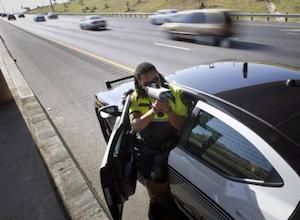
A radar speeding ticket in Georgia must clear a strict chain of admissibility requirements before it holds up in court. Radar bounces a radio signal off a moving vehicle. The beam widens as it travels, so in heavy traffic it can return a reading from more than one car. Clients often tell us they are certain the officer locked onto a nearby vehicle instead of theirs. That identification error is real, but it is hard to prove without video, and a radar citation rarely collapses on that argument alone.
Georgia's speed detection statutes set specific admissibility requirements for radar. The device must be a model approved by the Georgia Department of Public Safety and appear on the DPS-approved device list. The law enforcement agency must hold a current, valid speed detection device permit issued by DPS. The officer operating the unit must have completed training and hold individual certification for that device type.
Each device must also be certified for compliance by a qualified technician before it goes into service and once a year afterward. Officers run their own accuracy checks, such as tuning fork tests, and those results should be logged. A defense lawyer subpoenas the agency's DPS permit, the officer's individual training certificate, the device calibration log for the date of the stop, and the DPS device list to confirm the specific unit is approved.
Under Georgia's signage rule, warning signs must be posted on every state highway at the point where it enters the jurisdiction. Each sign must be at least 24 by 30 inches and must warn drivers that speed detection devices are in use. The statute also prohibits operating a detection device within 500 feet of any such warning sign.
The 10 mph tolerance adds another layer. No county, city, or campus officer may make a speed detection case unless the clocked speed exceeds the posted limit by more than 10 mph. This threshold does not apply in properly marked school zones around school hours, historic districts, or residential zones with posted limits under 35 mph. It also does not apply to Georgia State Patrol troopers.
Finally, no device may be operated within 500 feet of a sign warning of a change in the posted speed limit. A reading taken inside that buffer zone is open to challenge.
Laser – or LIDAR – works differently. The beam is narrow and targets a single vehicle, so target confusion is a much weaker argument. A laser challenge usually turns on operator technique, the aiming distance, device certification, and the same statutory permit and testing rules that apply to radar.
Clients ask us directly: can I beat a laser speeding ticket? It may be possible in some cases. The device may have lacked current certification, or the officer may have lacked a valid permit. The required signage may have been missing, or the reading may fall under the 10 mph threshold. The answer depends on the facts and the court, and no attorney can promise a dismissal.
With pacing, the officer follows at a supposedly constant distance and reads his or her own speedometer. The challenge looks at speedometer calibration, how far the officer actually paced, traffic and terrain, and whether the officer was closing the gap.
VASCAR is a time-over-distance calculation. The officer marks a start point and an end point, and the unit computes the speed. Because the math depends on human reaction time at both marks, small timing errors produce large speed errors.
A trained, certified officer may also give a visual speed estimate, which Georgia courts accept. It stays subjective, and it is generally weaker corroboration than a certified device reading.
Officers often pair an estimate with a device reading. The speed in the officer's report and the speed on the citation do not always match. That mismatch is one of the first things worth checking.
The fine for running a stop sign in Georgia depends on the court. Each municipal, recorder's, or state court sets its own fine schedule within the statutory cap, then adds mandatory state surcharges. Those surcharges often more than double the printed base amount, so the total you actually owe at the window is well above the figure a driver expects. Check the citation and the court's current schedule rather than trusting a single dollar amount quoted online.
Under Georgia law, every driver must come to a complete stop at a stop sign at the clearly marked stop line. When no stop line is marked, the driver must stop before entering the crosswalk on the near side of the intersection. When there is no crosswalk, the driver must stop at the point nearest the intersecting roadway where the driver has a view of approaching traffic. After stopping, the driver must yield the right of way to any vehicle in the intersection or approaching so closely that it creates an immediate hazard. A rolling stop – slowing but never fully stopping – is the most common charging basis.
Because a stop sign violation falls under the traffic code, it is a misdemeanor under the same default rule that applies to speeding. The general misdemeanor cap allows a fine up to $1,000 or up to 12 months of confinement, or both. Most courts assess far less for a routine stop sign violation. After base fines and surcharges, the total in metro Atlanta municipal courts commonly runs well above the base fine, though the exact amount varies by jurisdiction.
The penalty for running a stop sign goes well beyond the dollar amount of the fine. A conviction adds three demerit points under the Department of Driver Services schedule. Those points stack with points from any other moving violation. A driver who reaches 15 points in any 24-month period faces license suspension.
Drivers under 21 face a much lower threshold. Four points from a single offense can trigger a suspension for a young driver. CDL holders also face tighter rules – a serious traffic violation conviction on a CDL can lead to federal disqualification, and a stop sign violation may count depending on the circumstances.
Insurers treat a stop sign conviction as a moving violation. Premium increases typically last for years. Over that span, the insurance cost often exceeds the fine by a wide margin.
Drivers often assume a rolling stop citation is not worth contesting, then find that the points threaten the license. These cases frequently turn on the officer's line of sight to the intersection. They also turn on whether the stop line was visible or obscured by faded paint, gravel, or a parked vehicle. That is why they are contested far more often than most drivers expect.
See our related guide: Illegal U Turn Ticket in Georgia: Cost, Points, and How to Fight It.

Speeding in a marked Georgia work zone carries its own enhanced penalty, separate from the ordinary speeding fine schedule. A conviction for speeding in a designated highway work zone is a misdemeanor of a high and aggravated nature, punishable by a fine of $100 to $2,000 or up to 12 months in jail, or both. Construction zones and temporarily reduced speed areas can also draw extra fees imposed by the judge.
The enhancement is not automatic. The zone must be properly signed under state requirements. The state must also show the zone was active, meaning work zone personnel were present or barriers, work vehicles, or pavement drop offs were there. An unsigned stretch of highway that used to be a work zone is not the same as a live one.
That is where the section earns its value for a driver. Whether the signage complied, and whether the zone was active at the time of the stop, are both checkable facts. Photographs, the agency's traffic control plan, and the contractor's schedule can all be requested. Depending on what those records show, the enhancement may not survive, even when the speed itself is not really in dispute.
Can you go to jail for speeding in Georgia? Legally, yes. Speeding is a misdemeanor, and a misdemeanor sentence may include custody. In practice, judges reserve jail for a narrow set of cases.
Custody becomes a real risk in four situations. The speed is extreme. The state files a reckless driving charge alongside the speeding count. The driver has a run of prior convictions. Or the driver appears on a bench warrant after missing a court date.
Most first-time cases at moderate speeds resolve without jail, though outcomes vary by court and by record.
The reckless driving crossover matters most. Georgia charges reckless driving when a driver operates a vehicle in reckless disregard for the safety of persons or property. Very high speeds often draw that charge, and it carries the full misdemeanor exposure of up to 12 months.
Since the pandemic-era rise in high-speed driving, some judges in metro Atlanta courts have imposed jail on drivers clocked at 100 mph or more. Atlanta Municipal Court is among them.
Super speeder status is a separate layer. Georgia's super speeder law reaches drivers convicted at 75 mph or more on a two-lane road, or 85 mph or more on any road. The officer does not write it as a charge. After a conviction, the Department of Driver Services assesses a separate state fee on top of whatever the court imposed. A driver who does not pay that fee within the statutory window faces a license suspension and a reinstatement fee.

For a first violation, most adult drivers do not face license revocation, and insurers may not react to a low-speed citation. Points still accumulate, and the picture can change quickly with speed and with prior convictions.
Georgia law caps speeding fines on a graduated scale. The cap climbs with how far over the limit the driver was clocked. It starts low for the smallest overages and reaches several hundred dollars at the top tier. Confirm the tier that matches your clocked speed against the current code section or the court's schedule, because the citation itself usually does not show it.
The cap is not the amount due. Georgia adds mandatory state surcharges to every traffic fine, and local courts add their own fees. Together they often push the total far above the base fine. Work zone and super speeder cases add more on top of that.
Demerit points are the other half of the cost. Georgia assigns no points for speeding under 15 mph over the limit. Above that line, the schedule runs from 2 points up to 6 points at the highest speeds. Most other moving violations carry 3 points under the catch-all in the schedule. A driver who reaches 15 points in any 24-month period faces suspension, and drivers under 21 hit suspension at a far lower total. The Department of Driver Services publishes the full point schedule and calculates each driver's balance automatically.
Some serious offenses do not turn on demerit points at all. A DUI or hit and run conviction triggers a license suspension by operation of law rather than through the point system.
Cost comes back to the misdemeanor framing. The fine is usually the smallest piece. Insurance increases run for years, and the criminal conviction stays on the record long after the ticket is paid.

If you were caught speeding in Georgia, the citation in your hand is a criminal charge with a hard court date. Missing that date turns a routine traffic case into a failure to appear. That can bring a bench warrant and a license suspension on top of the original charge. It is the costliest mistake drivers make after a traffic stop.
A free case review with a speeding ticket lawyer starts with four things: the citation itself, the detection method the officer used, the device and permit records behind the reading, and your current driving history and point balance. From there, the lawyer can identify possible resolutions – a reduction to a lesser offense, a nolo contendere plea to limit collateral consequences, dismissal based on procedural defects, or completion of a defensive driving course where the court allows it.
Kohn & Yager LLC focuses on Georgia traffic misdemeanors and criminal defense. Our lawyers appear in the municipal, recorder's, and state courts across metro Atlanta where these charges are heard – including courts in Fulton, DeKalb, Cobb, and Gwinnett counties. Drivers cited inside the city limits can start with our Atlanta speeding ticket page, which walks through the fines, the points, and the super speeder fee. Have the citation, your license, and any prior citations in front of you when you call.

No firm can promise a dismissal or a reduction. A review tells you what the state has to prove, what your record can absorb, and what your realistic options are. The consultation is free, and calls are answered 24 hours a day. Past results do not guarantee a similar outcome.
There is no single statewide amount. The court handling the citation sets the fine from its own schedule, within the statutory cap, and mandatory state surcharges are added on top. The total due is often more than double the base fine, so check the citation and the court's current schedule.
Yes. Under Georgia law, a speeding violation is a misdemeanor unless a statute declares otherwise. A conviction is a criminal conviction and may appear on background checks. That is why some drivers fight a ticket they would otherwise simply pay.
Whether you can beat a laser speeding ticket depends on the specific facts of your stop. Laser – or LIDAR – targets a single vehicle with a narrow beam, so challenging target identification is harder than with radar. Instead, defenses focus on the device and the operator.
First, the LIDAR unit must be a model approved by the Georgia Department of Public Safety and must have current calibration certification. Officers are trained to perform a fixed-distance test and verify scope alignment before using the device on a shift. If those checks were skipped or the logs are missing, the reading may be challenged.
Second, the officer must hold individual LIDAR training certification and the agency must hold a valid DPS speed detection permit. A lapsed permit or expired training certificate can undercut the reading.
Third, operator technique matters. The officer must have had a clear line of sight and must have aimed at a specific reflective surface on a single vehicle rather than sweeping across a group. Aiming errors – especially at long distances – can produce unreliable results.
The same 10 mph tolerance that applies to radar also applies to LIDAR readings by county, city, or campus officers outside of school zones, historic districts, and residential zones. Warning signs must be posted.
Common outcomes when a challenge has merit include reduction to a non-reporting offense, a nolo plea, or dismissal. An outright acquittal after trial is less common. Every case turns on its own facts, and no lawyer can guarantee an outcome.
A conviction typically adds three points under the Department of Driver Services schedule. Fifteen points in a 24-month period triggers suspension for most drivers, and drivers under 21 face a much lower threshold. Confirm your current balance with DDS before you decide how to handle a citation.
Often, but not automatically. The state must show the agency held a valid speed detection permit. It must also show the device was tested and certified and the officer was trained. If any link in that chain is missing, the reading may be open to challenge.