TOP-RATED
Atlanta Criminal Defense
Law Firm
Atlanta Criminal Defense
Law Firm




Georgia treats most impaired driving cases as misdemeanors. A crash changes the exposure. Impaired or reckless driving that kills someone becomes felony vehicular homicide. Driving that causes a qualifying injury becomes serious injury by vehicle. Either charge moves to Superior Court on a grand jury indictment. This page covers how Georgia grades those felony vehicular charges and what each one carries. It also covers when an aggravated assault count gets added, and where the defenses lie.

Most DUI arrests in Georgia end in misdemeanor charges. A first, second, or third conviction is a misdemeanor. A fourth conviction within ten years is a felony. The ten-year period is measured from arrest dates.
Repeat offenses are not the only path to a felony. A single DUI-related crash that kills another person is charged as homicide by vehicle in the first degree. A crash that causes a qualifying injury is charged as serious injury by vehicle. Reckless driving that kills or seriously injures someone carries the same exposure. No prior record is needed for either charge.
That shift changes how the case moves. Misdemeanor DUI cases proceed on an accusation. Felony vehicular cases go to a grand jury in Superior Court. The window before indictment is often the best chance to shape what the State charges.
First-degree homicide by vehicle applies when a driver causes another person's death through one of a short list of violations. Those are DUI, reckless driving, fleeing or attempting to elude a police officer, unlawfully passing a school bus, and leaving the scene of a fatal crash. Conviction carries imprisonment for not less than three years nor more than 15 years.
The State must prove two things. First, that the driver committed one of those underlying violations. Second, that the violation caused the victim's death. The charge does not require malice aforethought. The prison exposure is severe anyway.
A separate subsection covers drivers declared habitual violators whose licenses are in revocation. A habitual violator who causes a death faces five to 20 years. At least one year must be served in the penitentiary before any part of that sentence may be probated or suspended.
Second-degree homicide by vehicle is different. It applies when the death resulted from some other traffic violation, outside the list above. Second-degree homicide by vehicle is punished as a misdemeanor. The gap between the two degrees is enormous. Whether the underlying conduct qualifies as DUI or reckless driving often decides whether a driver faces years in prison or a misdemeanor sentence.
Serious injury by vehicle is a felony. It applies when a driver causes an accident that results in bodily harm. The driver must be violating Georgia's DUI law or its reckless driving law at the time. Malice aforethought is not required. Conviction carries imprisonment for not less than one year nor more than 15 years.
The statute defines "bodily harm" narrowly. The injury must deprive the victim of a member of the body. Or it must render a member of the body useless. Or it must seriously disfigure the body or a member of it. Or it must cause organic brain damage that renders the body or a member useless. Broken bones, cuts, and soft tissue injuries are painful. Serious physical injury alone does not automatically meet that definition. The narrow threshold is often litigated before trial.
Two points follow from the statute's wording. Intent to harm is not an element. The State proves the predicate traffic violation and the qualifying injury instead. The offense is also defined by injury to another person. So prosecutors commonly bring a separate count for each person seriously injured in one collision. One crash can produce several counts.
A separate subsection reaches a driver who knew an accident caused bodily harm and then left the scene. That version carries one to ten years.
Some readers search for "serious injury by dangerous driving." Georgia does not use that phrase. The equivalent charge here is serious injury by vehicle. Our page on DUI with serious injury covers the predicate DUI charge in more detail.

Prosecutors sometimes add an aggravated assault count alongside a vehicular homicide or serious injury by vehicle charge. Sometimes it is charged instead of them. This happens most often in road rage incidents and intentional ramming cases. It can also happen when a driver uses a vehicle to flee police and strikes someone.
The phrases "aggravated assault by vehicle" and "aggravated assault with a vehicle" describe the same charging theory. Georgia has no standalone vehicular assault statute, so vehicular assault charges are brought as aggravated assault. The motor vehicle is charged as the deadly weapon or offensive instrument under Georgia's aggravated assault statute. That statute reaches an assault committed with any object, device, or instrument. Used offensively against a person, the object must be likely to result in serious bodily injury, or must actually cause it. A car can qualify.
The State must prove two elements. The first is an assault under Georgia law. That means an attempt to commit a violent injury, or an act that places another in reasonable fear of immediately receiving one. The second is use of the vehicle as a deadly weapon or offensive instrument. A vehicle is not a deadly weapon by itself. Whether it became one is a question for the jury.
Intent is the dividing line. Aggravated assault requires proof that the driver meant to injure or threaten someone with the vehicle. It does not require the driver to have been DUI. Serious injury by vehicle needs no proof of intent at all, because it rests on a predicate traffic violation plus a statutory injury. That is why road rage collisions and intentional ramming draw aggravated assault counts and ordinary impaired driving crashes usually do not. One collision can still support both counts.
Conviction carries imprisonment for not less than one nor more than 20 years. Higher ranges apply in specific situations. One is an aggravated assault knowingly committed against a public safety officer on duty. That range is five to 20 years. A three-year mandatory minimum applies to a defendant at least 17 years old. Another is an aggravated assault against a victim who is 65 or older. That range is three to 20 years.
Felony vehicular cases turn on a handful of evidence types. A criminal defense attorney targets the weakest links in the State's case.
Challenging the accident reconstruction. The State relies on its reconstruction team's conclusions about speed, point of impact, and sequence of events. Independent reconstructionists and downloads from the vehicle's event data recorder may contradict them. Those records can be overwritten quickly, so preserving them early matters. Our firm uses these experts.
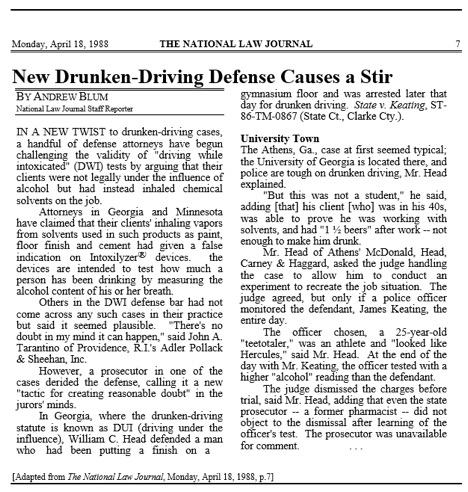
Challenging the underlying DUI. For serious injury by vehicle and first-degree homicide by vehicle, the predicate charge is the foundation. If it fails, the felony vehicular count usually falls with it. Common challenges target breath test maintenance records and blood draw chain of custody. Another asks whether the implied consent notice was read as the statute requires. Another asks whether the traffic stop was lawful at all. Georgia law also sets out how breath and blood tests must be performed before the results are admissible. The testing must follow approved methods. The machine must be properly maintained. A permit holder must run it. Breath testing takes two sequential samples, and the readings must agree within 0.020 grams.
Attacking intent. On an aggravated assault count, intent is the State's hardest element. The State proves beyond a reasonable doubt that the driver acted deliberately, or the count fails. A momentary lapse, a panic reaction, or a defensive swerve is not the criminal intent the statute requires.
Testing the injury threshold. Serious injury by vehicle requires an injury that meets the statutory definition. That means loss of a member, a member rendered useless, serious disfigurement, or organic brain damage. Many charged injuries do not clearly meet it. A pretrial challenge to the injury element may reduce or dismiss the count.
Challenging causation. The State must tie the death or injury to the defendant's violation. Injuries may trace to a pre-existing condition, a third driver, or the victim's own conduct.
Challenging the deadly weapon theory. A driver who lost control because of a medical event, mechanical failure, or road conditions did not use the car offensively. Whether the vehicle became a deadly weapon is a jury question.

Mitigation for sentencing. When the evidence of guilt is strong, early mitigation work matters. Restitution, treatment, community ties, and the absence of a prior record may influence whether a judge imposes prison time or probation. Georgia's First Offender Act is also worth examining. A defendant with no prior felony conviction may be sentenced before any adjudication of guilt. On successful completion that defendant stands discharged without a conviction. Not every offense or defendant qualifies. Violating the terms lets the court enter an adjudication of guilt and resentence.
A felony vehicular homicide, serious injury by vehicle, or aggravated assault by vehicle charge in Georgia carries years of prison exposure. The stakes extend beyond incarceration. A conviction can end firearm rights, trigger license revocation, and create a permanent felony record. That record affects employment and housing.
Evidence in these cases changes fast. Black box data from the vehicle may be overwritten within days. Surveillance footage from nearby businesses is often recorded over on a short loop. The State's accident reconstruction team begins work at the scene. The grand jury may hear its version first. Getting an experienced Georgia DUI attorney involved early is the best chance to preserve favorable evidence. Early counsel also addresses the parallel license suspension and shapes what the State charges before an indictment.
Kohn & Yager LLC offers a free consultation on Georgia felony vehicular cases. Our criminal defense attorneys include DUI lawyer William "Bubba" Head. These defense attorneys have handled felony DUI and vehicular cases in Georgia courts for decades. That work includes grand jury proceedings in Fulton, DeKalb, Gwinnett, and Cobb County Superior Courts. We are available 24 hours a day, 7 days a week. Call 404-567-5515 to speak with a licensed Georgia attorney about your situation. Every case is different and results depend on the specific facts.

Yes. Aggravated assault is a felony punishable by one to 20 years, and there is no misdemeanor version. Serious injury by vehicle is also a felony, punishable by one to 15 years.
Serious injury by vehicle rests on a predicate traffic violation, DUI or reckless driving, plus a qualifying injury. No intent to harm is required. Aggravated assault by vehicle requires proof that the driver used the vehicle as a deadly weapon or offensive instrument. The ranges differ too. Serious injury by vehicle carries one to 15 years. Aggravated assault carries one to 20 years.
First-degree homicide by vehicle carries three to 15 years. If the driver had been declared a habitual violator and the license was in revocation, the range is five to 20 years. At least one year must be served in the penitentiary before any part of that sentence may be probated or suspended.
Yes. Aggravated assault does not require a DUI. It requires proof that the driver used the vehicle as a deadly or offensive weapon with intent to injure or threaten. Road rage incidents and intentional ramming are common examples.
No. Georgia does not use the phrase "serious injury by dangerous driving." The equivalent Georgia charge is serious injury by vehicle. The predicate conduct, DUI or reckless driving, is what other jurisdictions sometimes label dangerous driving.
The statute defines bodily harm narrowly. The injury must deprive the victim of a member of the body. Or it must render a member useless. Or it must seriously disfigure the body or a member of it. Or it must cause organic brain damage that leaves the body or a member useless. Injuries outside those categories may not support a conviction, even severe ones. The threshold is frequently challenged before trial.
Sometimes. Prosecutors may dismiss or reduce a count when the intent evidence is thin. Reconstruction that contradicts the State's theory helps. Charges may also fall when the injury does not meet the statutory definition. A grand jury can return a no bill. No outcome can be promised.
Georgia's general limitation period for felonies is four years from the date of the offense. The period is seven years when the victim was under 18 at the time of the offense. In practice prosecutors often present these cases to a grand jury within months of the crash. That window is the best time to bring defense evidence forward.